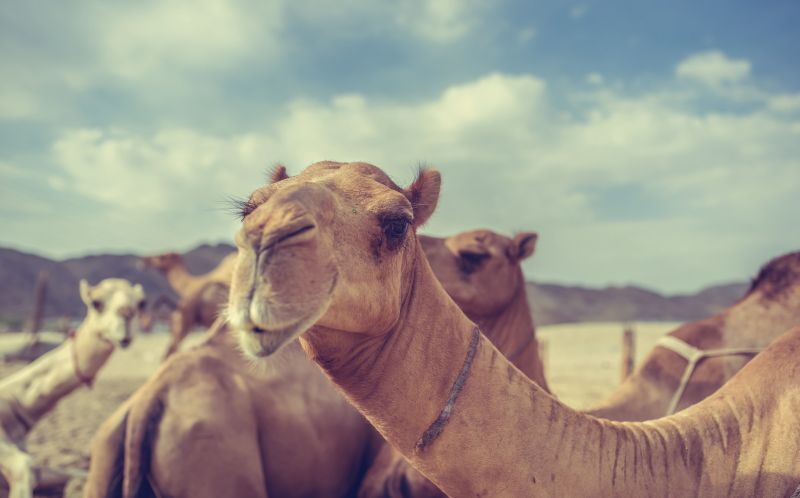
I remember a time when people were shy to show the pride they had for camels. Somehow through a colonialist view the camel became a symbol of regression.

I always found that dumbfounding, how can something so beautiful be synonymous with a lack of progress even though they were literally vehicles of progress in a land where no modern vehicle could progress.
Perhaps there is no human animal relationship in the world that is so deep and intricate which people have so many different ways to describe camels.
Take for examples the types of female camels. Most people are familiar with the word naga (ناقة)she camel, but here are some more:
Hayel (حايل): a she camel that is of breeding age but whose owner has not found her a suitable mate
Mussayar (مسير) – Mujassar (مجسر): A female camel ready to breed
Mu’ashar (معشّر): Female camel in the early stages of pregnancy
Leg’ha (لقحة): A camel that have been pregnant for four months
Khilfa (خلفة): A camel that gave birth in a period of less than 6 months.
Ishra (عشرا): A camel that gave birth in a period of more than 6 months.
Al-Ashwa ( العشواء ) : A clumsy she camel
Khalooj (خلوج): A camel whose calf died young and she still misses it.
Khafoot (خفوت): A camel whose calf died and she already forgot about him.
Mudhayira (مضيّرة): A camel that mothers calves camels that are not her own.
Masooh (مسوح): A camel that can be forced to produce milk in absence of her calf by constantly milking her.
Nahoos (نحوس): A camel that doesn’t allow her owner to milk her.
Jadhoor (جضور): A camel that produces a lot of butter during milking or the one who bellows a lot while being milked.

Arabic is a language of detail.
Here is a list of Arabic words that describe the numerical groupings of camels, just to give you a sample!
The more you know the more you can feel. Imagine if someone asks you How is your Dhoed? Instead of having a face of confusion, with confidence you can say to him “جعلك بزود” or may God give you more.
Dhoed (ذود): Three to 10 camels.
Zeema (زيمة): Two to 15 camels.
Rosl (رسل): َAbout 10 camels, or between 15 and 25.
Sarma (صرمة): Ten to 30 camels.
Sada’a (صدعة): About 60 camels.
Okra (عكرة): Up to 70, or between 50 and 100.
Jool (جول): Thirty to 40.
Hind (هند) or Hunaida (هنيدة): One hundred.
Garj (قرج): About one hundred and fifty, or between 500 and 1,000.
Laila (ليلى): Three hundred camels.
Hawm (حوم) : More than 1000.
There are literally hundreds of words that specifically describe camels, and their behavior. This is a long list based only on their rehydration behavior. Not all camels drink alike and the Arabic language kept the receipts.

Al Ghib (الغِبّ): This camel drinks water every two days.
Al Ghib al-Tall (الغِبّ الطل): This camel goes to the basin to drink during the day.
Ar-Rub’ (الرُّبع): This camel drinks water every three days.
Az-Zahira (الظَّاهِرة): This camel drinks water every day.
Ar-Raffah (الرَّفّة): This camel drinks at any time.
Al-Qasrid (القَصْرِيد): This camel drinks only a small amount of water.
Al-Arja’ (العَرجاء): This camel drinks once in the morning and once in the evening.
At-Tandiyyah (التَّنْدِيَة): This camel returns to the basin to drink again.
As-Saluf (السَّلُوف): This camel leads the other camels to the water.
Ad-Dafun (الدَّفُون): This camel stays in the middle of the herd as they approach the water.
Al-Hafah / Al-Milwah (الهَافَة / المِلْوَاح): This camel becomes thirsty quickly.
Al-‘Uyuf (العُيُوف): This camel smells the water but rarely drinks.
Al-Muqamiḥ (المُقَامِح): This camel refuses to drink until it overcomes its pain.
Ar-Raqub (الرَّقُوب): This camel will not drink from a crowded basin; it waits and watches.
Milhah (مِلْحاح): This camel hardly leaves the watering place.
Mirad (مِيراد): This camel rushes eagerly to the basin.
Hiyam (هِيام): This camel suffers intense thirst.
Leave a Reply