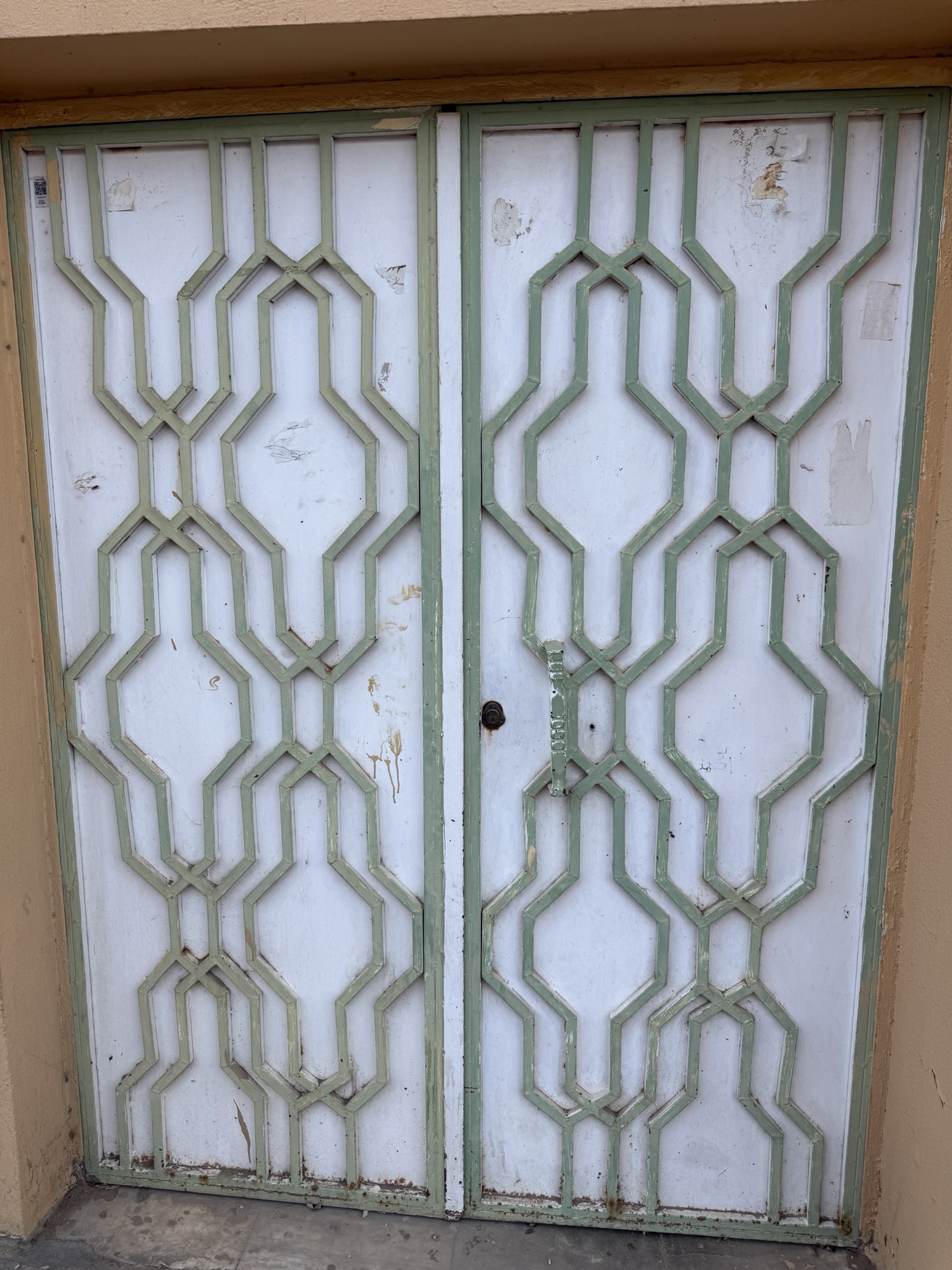

Across the sandstone valleys of AlUla, where ancient inscriptions meet the whispers of palm leaves, even the simplest doorway tells a story. These doors — often overlooked by hurried visitors — are among the most intimate artifacts of the town’s vernacular architecture. Each bāb (باب, door) stands as a threshold between the private and public worlds of old Arabia, preserving the craftsmanship, geometry, and lived traditions of the oasis.

Geometry and Pattern
AlUla’s doors, typically made of palm trunks, tamarisk wood, or later iron, reflect the region’s evolving material culture. The motifs etched or welded into their surfaces — diamonds, lattices, arabesques — are not mere ornamentation. They are echoes of ʿilm al-zakhrafa (علم الزخرفة), the art of geometric design, which emerged from a philosophy where symmetry mirrored divine order. The recurring diamond shape, murabbaʿ (مربّع), often symbolized protection and balance — guarding the household from chaos and inviting harmony within.

Color, Rust, and Time
The doors in AlUla’s old town, weathered by desert winds and sun, are canvases of natural patina. Layers of fading paint reveal decades of repainting — a quiet ritual of care that reflects both continuity and decay. The muted greens and ochres recall the oasis itself: life clinging to aridness. In many ways, these colors tell the same story as AlUla’s palms and mudbrick walls — resilience through adaptation.

Between Craft and Identity
Metalwork in older neighborhoods of AlUla became prominent during the mid-20th century, when blacksmiths began integrating wrought-iron grilles into door designs. These iron patterns, both protective and decorative, often carried family signatures — subtle deviations in line or curve that identified the artisan. Behind every welded flourish was a craftsman’s silent authorship, a continuity of the region’s ṣanāʿāt taqlīdiyya (صناعات تقليدية, traditional crafts).

A Living Archive


To walk through AlUla’s narrow streets is to pass through a living museum. Every door bears fingerprints, scratches, and traces of generations who entered and exited — merchants, children, travelers, and storytellers. As I stood before them, I could almost imagine the people who once walked through — voices echoing, footsteps soft against the earth, lives unfolding behind each frame. In that stillness, the doors seemed to breathe, carrying the memory of everyone who had ever passed their threshold.

Cultural Continuity
As AlUla’s restoration projects expand under Vision 2030 and the Royal Commission for AlUla’s heritage initiatives, many of these doors are being documented and preserved. Their survival is crucial, not as nostalgic relics, but as touchstones of continuity between past and future — physical metaphors for a nation in transformation.

Closing Thought
In a world rushing toward glass and steel, AlUla’s doors remind us that beauty once lived in the human hand — in the imperfect line, the uneven hinge, the rust that speaks of time. To stand before them is to stand before memory itself, where every knock once carried a story.
Leave a Reply