Don’t call them animals!
The camel is for the Arabs what blood is for the body. Without them Arabia would have never been the same.
In the eyes of the Arabs these gifts from God are not mere animals they in themselves were walking bank accounts, tribal ledgers, producing milk, meat, wool, providing transportation for goods and mobility to people.
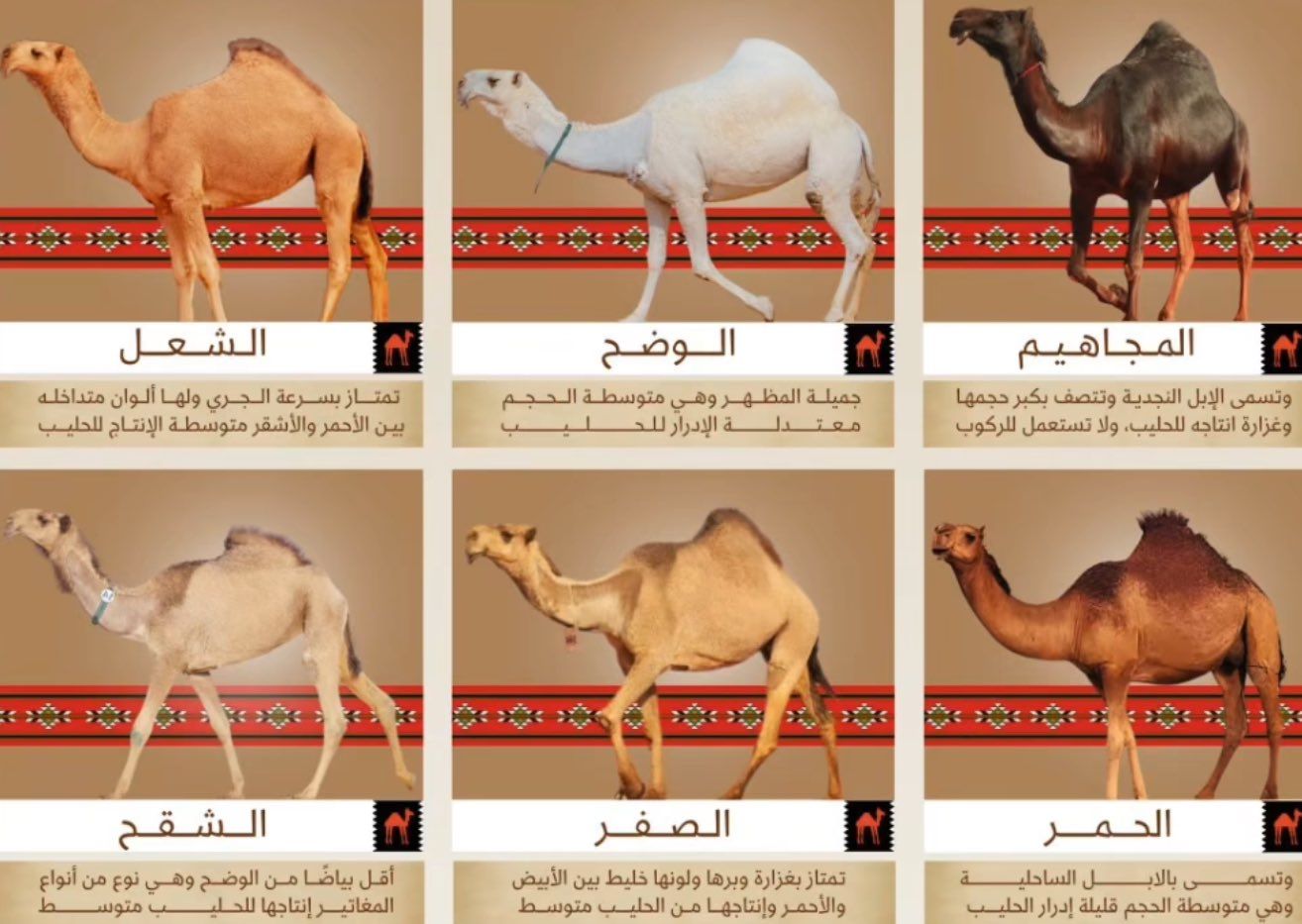
Here we see the six most valuable types of camel in the world of camel beauty. These six beautiful breeds are the pride and joy of millions of tribal people who showcase them as a sign of their mastery of the desert, its complete lack in natural resources, its enormous hardships, and a deep understanding love and appreciation for camels, and the tribal tension and cooperation needed to maintain and further pronounce the breed’s characteristics. They are mostly prized for their shape, form and milk production.
الشُّعْل — Shoal (ash-Sha‘al / “shah-AAL”)
Known for fast running. Its color blends between red and blond. Milk production is average.
الوَضَح — Wadhah (al-Waḍaḥ / “wa-DAH,” with emphatic d)
Attractive in appearance and medium-sized; milk yield is moderate.
المَجَاهِيم — Majahim (al-Majāhīm / “ma-ja-HEEM”)
Also called Najdi camels. Characterized by large size and abundant milk production. Not used for riding.
الشَّقَح — Sheqah (ash-Shaqaḥ / “she-QAH,” q = deep k)
Less white than Wadhah; a type within the Maghateer (light-colored) group. Milk production is average.
الصُّفْر — Sufr (aṣ-Ṣufr / “SU-fr”)
Noted for abundant hair/wool; color is a mix of white and red. Milk production is moderate.
الحُمْر — Humr (al-Ḥumr / “HOOM-r”)
Also called coastal camels. Medium in size with low milk yield.
AmericanBadu
Blog about the natural & cultural heritage of Saudi Arabia
about
I’m Joshua Van Alstine — an American writer and researcher living and working in Saudi Arabia. I document the natural and cultural heritage of the Arabian Peninsula, from Bedouin traditions to desert ecology, camel racing, falconry, and ancient history.
Posted in Cultural Heritage
Leave a Reply