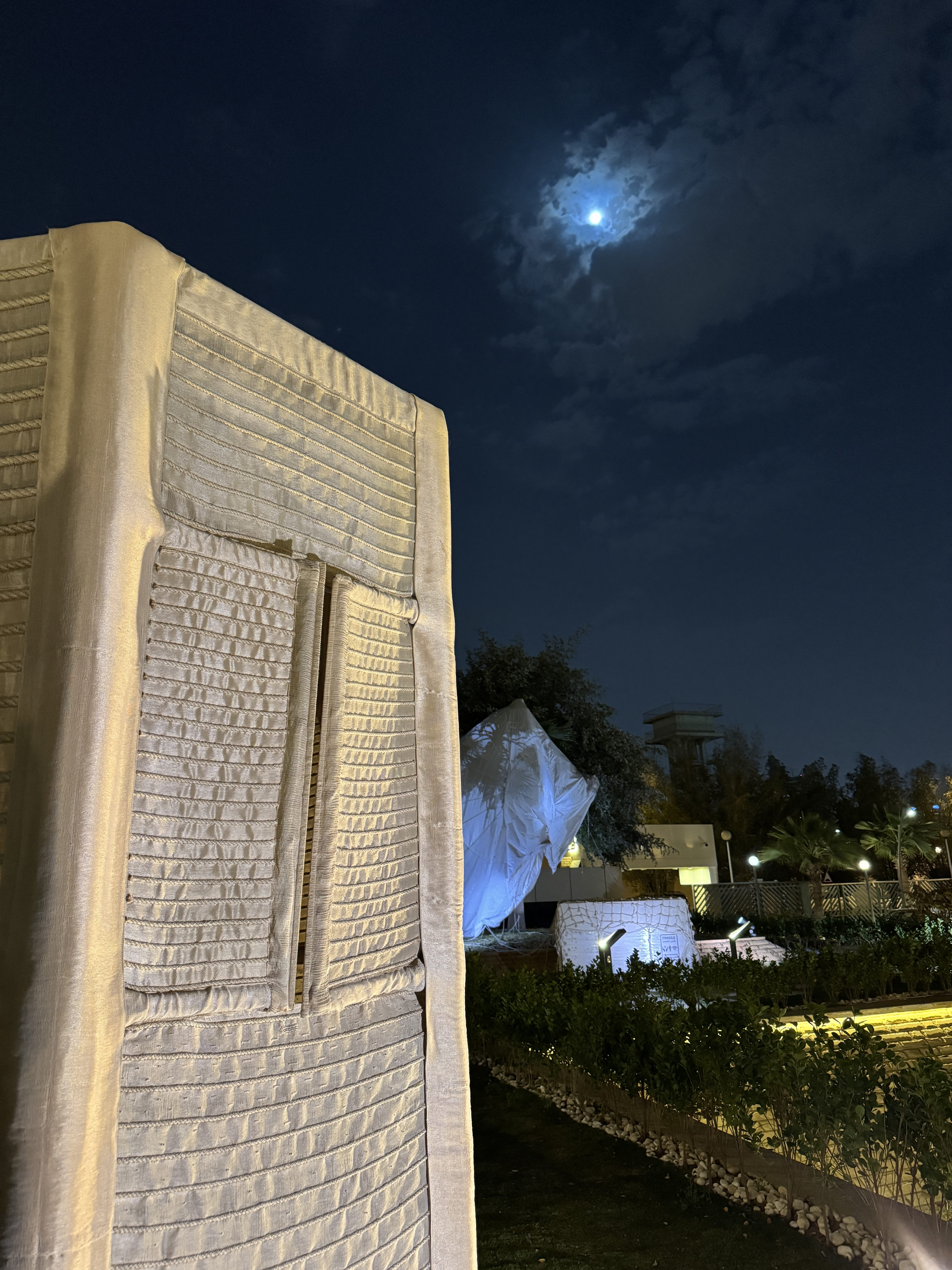
Bahraini artist Maryam AlJomairi’s Flexible Fabric and broader architectural research highlight a growing shift toward nature-inspired design, positioning her work as a blueprint for the future of biomimetic architecture. As an architect, researcher, and designer, she not only introduces novel materials and responsive systems but also sets a precedent for how future generations might rethink the built environment.

As the co-founder of the Saudi Arabian Botanical Society, I have encountered many projects that draw inspiration from nature, but AlJomairi’s installation was the most meaningful to me. It resonated deeply because it captures something that many architectural experiments fail to achieve—a genuine dialogue between the built environment and the natural world. Rather than simply mimicking nature’s forms, Flexible Fabric embodies its behaviors, mirroring the adaptability, responsiveness, and intelligence of living organisms.
I have always been fascinated by the cross-section between art, environment, science, and sustainability, and AlJomairi’s work masterfully brings all these elements together. She is not simply designing; she is questioning, experimenting, and reimagining architecture as something that can be both functional and deeply connected to ecological intelligence. This kind of interdisciplinary thinking is exactly what the future of design needs—a fusion of aesthetics, environmental responsibility, scientific exploration, and sustainable innovation.
One of the most intriguing aspects of Flexible Fabric is the poetic irony in its biological inspiration. Although the fabric she uses is described as “soft” and invites viewers to interact with it through touch, the plant that inspired it—the Mimosa pudica, commonly known as the “touch-me-not” plant—is known for doing the exact opposite.
In nature, the Mimosa pudica reacts defensively to touch, retracting its leaves in an instinctive response to external stimuli. It is a plant that discourages interaction, preferring to withdraw from engagement. Yet, AlJomairi reverses this mechanism in her work. Instead of retreating, Flexible Fabric embraces touch, using its softness and interactivity to create a sense of connection rather than avoidance.
This reversal is fascinating because it challenges traditional architectural narratives. Buildings have long been designed with a sense of permanence, rigidity, and even inaccessibility—spaces that resist interaction. AlJomairi’s approach, however, encourages architecture to be responsive, tactile, and participatory. By drawing from a plant that instinctively recoils but transforming its principle into something engaging and welcoming, she plays with expectations, asking viewers to reconsider how spaces should behave in response to human presence.
This contrast speaks to a broader idea in biomimicry: nature’s lessons are not absolute rules, but flexible principles that can be reinterpreted and adapted for different purposes. Just as the Mimosa pudica uses its reaction as a survival strategy, Flexible Fabric uses the concept of responsiveness to invite engagement rather than resist it. This shift offers a new perspective on how interactive materials can enhance human connection with architecture, rather than reinforcing a divide between the built and natural worlds.
One of the most powerful aspects of AlJomairi’s work is its potential to inspire peers and future generations to draw design solutions from nature. Biomimicry is more than an aesthetic or functional tool; it is a way of reorienting design philosophy toward sustainability, resilience, and harmony with the environment.
For instance, her study of the Mimosa pudica as a model for responsive architecture teaches an essential lesson: adaptability leads to survival. Plants that thrive in harsh conditions—whether the heat of the Arabian Peninsula or the cold of Northern Europe—do so by responding intelligently to their environment. What if future architects designed cities that could respond to temperature fluctuations, air quality, and human activity in similar ways? AlJomairi’s work presents exciting avenues for future research and innovation:
- Material Science & Sustainable Innovation: Future designers could develop self-repairing materials inspired by tree bark regeneration or create energy-efficient ventilation systems modeled after termite mounds.
- Adaptive Architecture: Buildings could incorporate light-sensitive facades, similar to how flowers open and close with the sun, to regulate energy use dynamically.
- Water Conservation & Smart Urban Planning: Architects could look to desert plants like succulents, which maximize water retention, to develop buildings that passively collect and store rainwater in drought-prone regions.
By pioneering these principles in her own work, AlJomairi is setting a precedent for young architects to look to the natural world as an instructional guide rather than simply as inspiration. AlJomairi’s research presents an open invitation to architects, designers, and material scientists: look beyond the conventional, learn from nature, and embrace the potential of biomimicry to reshape our world.
Among all the installations I have encountered, hers stood out as the most thought-provoking and meaningful—not only because of its beauty or technical complexity but because it demonstrates a future where architecture and nature are not separate entities but partners in shaping the world around us.
I find great inspiration in the intersection of art, environment, science, and sustainability, and AlJomairi’s work exemplifies this fusion in a way few others do. She is proving that architecture can be as alive as the world it inhabits, and I hope her work continues to inspire future generations to think beyond the blueprint—to design with nature, not against it.
Her work is a beacon for architectural futurists, urban ecologists, and sustainability pioneers, proving that nature’s wisdom is not a thing of the past—it is a roadmap to the future. As biomimicry gains momentum, it is my hope that more architects will follow her lead, ensuring that future cities are not just sustainable, but truly symbiotic with the natural world.
Leave a Reply