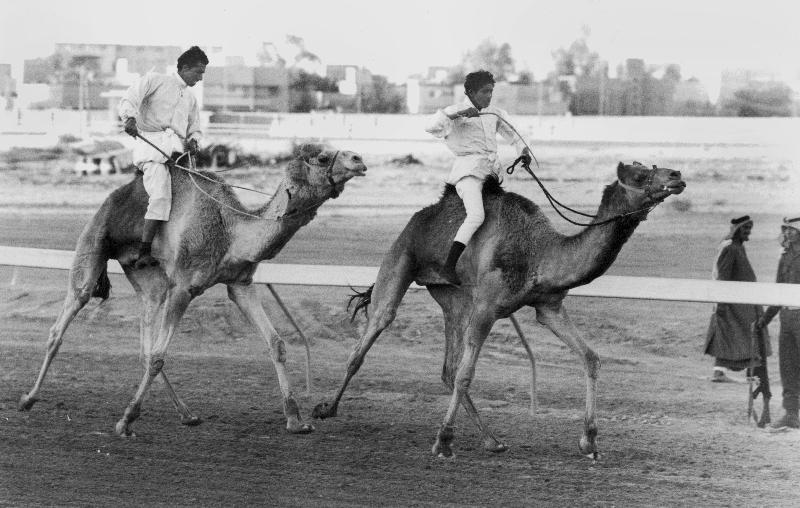
Why Gulf camel racing is reintroducing adult jockeys in the age of robots
Camel racing in the Gulf has spent the last two decades defined by an object: a small robot strapped to a saddle, controlled from a convoy of cars running parallel to the track. That robot did not appear because the region wanted to “remove humans from tradition.” It appeared because the sport had a structural problem: racing rewards lightness, and for many years that logic pulled the sport into an abusive reliance on children as riders. Once governments tightened bans and enforcement, and once international scrutiny turned that reality into a reputational and moral crisis, robots became the practical workaround that kept the sport alive.

Now, a different shift is underway: in Saudi Arabia and across the wider Gulf ecosystem, adult human jockeys are reappearing more regulated, more professionalized, and increasingly visible, including women in formal competition. This is not a return to the old system. It is a recalibration: robots solved an ethical emergency; humans are returning because the sport is now trying to solve a different set of priorities skill, spectacle, safety standards, and a growing economic and cultural industry around camel sport.

Camel racing is often described as an “ancient sport,” and in a broad cultural sense that is true: people have used camels for travel and prestige across Arabia for centuries, and speed, breeding, and endurance have long been points of pride. But what most audiences today recognize as “camel racing” organized tracks, scheduled seasons, major prize structures, vehicle convoys, veterinary monitoring, federation governance is a modern sports system built on older relationships between people and camels.
This matters because it prevents a lazy story: robots did not “replace tradition.” Robots replaced a harmful practice that developed inside a modernized prize-driven racing economy.
Why robots became the default: the weight problem
The reason robots became normal is straightforward: lighter riders generally allow faster race performance, especially across long distances. That incentive pushed the sport toward ever-lighter jockeys.
The timeline differs by country, but the pattern is consistent: bans and crackdowns accelerated in the 2000s, and robot jockeys filled the vacancy. In a BBC Witness History episode, the origin story is described in simple terms: a Qatari engineer proposed robot jockeys in 2003, and within two years the robot was approved for use. In the UAE, the transition is also tied to government bans and enforcement steps in the early-to-mid 2000s, with robots increasingly normal afterward.

A 2007 NPR report captured the moment robots were becoming mainstream at tracks near Dubai, including the DIY engineering culture around early devices and the basic reality that owners and trainers could now “ride” the race from their cars.
So why bring humans back, now?
If robots solved the sport’s central ethical crisis, why reintroduce humans at all?
Because the sport is no longer only trying to avoid inefficiencies. It is trying to become a fully professionalized, globally legible sport without losing the deeply human skills that make hijīn racing more than a mechanical time trial.

In the Saudi context, the turning point is institutional. The Saudi Camel Federation / Saudi Camel Racing Federation was established in 2018, and its purpose stated in its own materials and reflected across Saudi sports coverage centers on governance, development, and raising standards.
Professionalization changes incentives. Once you have licensing, age rules, safety requirements, and organized competition formats including dedicated races for riders, the presence of trained adult jockeys becomes an asset rather than a liability.

It also changes the moral equation. A regulated adult jockey system is categorically different from the historical child-jockey problem. The aim becomes: protect the rider, protect the camel, and keep the competition credible.
One sign of this shift is the formal entry of women into recognized events. In September 2025, women riders achieved first-ever wins at the Crown Prince Camel Festival in Taif, with officials explicitly framing it as part of the sport’s development.
It is a new phase: a sport building a legitimate athlete pathway for men and women under stricter rules than the pre-robot era ever had.

Mardhi Khamali is a Saudi writer and researcher whose work focuses on hijīn culture and the deeper history of “speed camels” in Arabia. He is the author of Khafaf (خفاف) widely regarded as the first dedicated book to specifically document and contextualize hijīn and the elite lineages of racing camels, tracing their roots from early human–camel domestication through material evidence such as rock art and ancient inscriptions. In the interview below, Khamali separates what is genuinely ancient (camel riding, fast-camel imagery, and the poetic world around camels) from what is modern (formal racing as an organized sport), and he explains why human jockeys have returned today under stricter regulation, safety standards, and a rapidly growing camel-sports economy.
1) How ancient is racing with human jockeys, and what evidence do we have?
Mardhi’s view is that written “sport history” is thin, and that the deeper evidence comes indirectly—especially from rock art and early inscriptions. He points to rock drawings that show camels carrying human riders, and he links “fast camels” to the way certain inscriptions describe camels as swift, including appearances in Thamudic contexts. His claim is not that we have modern “race records” from antiquity, but that the idea of speed camels and mounted camel movement appears early in Arabia’s material record.
2) Women have historically ridden camels. Were women racing camels historically?
Mardhi draws a clear distinction: women riding camels is not new, because camels were a primary transport system. He specifically mentions الهودج (al-hawdaj / al-hawdaj), the women’s riding structure used for travel. But he also argues that “speed racing” as an organized sport took its recognizable social form later—especially after the unification of the Kingdom—while earlier references are more situational, connected to travel urgency, raids, or reaching water sources.
3) Are there poems that address camel racing?
Mardhi anchors poetry in the camel world generally, then narrows toward forms associated with camel movement and hijīn culture. He mentions الرجز (rajaz) as early camel-linked verse rhythm and then بحر الهجيني (bahr al-hijīnī) as strongly associated with hijīn culture. He notes that pre-Islamic and Islamic-era poetry frequently refers to elite riding camels (naaqah, qaloos), because these terms often imply high-value, swift animals.
He provided this historical verse as an example:
ويَوْمَ عَقَرْتُ لِلْعَذَارَي مَطِيَّتِي
فَيَا عَجَباً مِنْ كورها المُتَحَمَّلِ
4) Human jockeys disappeared and reappeared. Why?
Mardhi connects this to modernization and mobility: once cars and urban life reshaped daily movement, the camel stopped being a daily necessity for most people. Camel sport persisted, but its format shifted. He describes a renewed state-level interest beginning in King Faisal’s era, and he recalls an older long-distance race attributed to King Abdulaziz (his wording places it from north Riyadh into central Riyadh, over 80 km).
On the modern racing timeline, Mardhi’s key point is this: around 2007/2008 (approximately), human jockeys stopped and robot jockeys were used. Then, after the establishment of the Saudi Camel Federation in 2018 and increased support, human jockeying returned in a more regulated and safer form for both rider and camel, with stronger financial incentives and a clearer economic ecosystem around the sport.
5) What camel age group is most ideal for racing?
Mardhi does not give a single category label in this message, but he frames racing selection around performance readiness and structured competition categories. Practically, owners work within the event’s approved divisions (age/class categories) and develop camels progressively.
6) What makes an ideal jockey?
Mardhi’s answer is blunt: weight and fit matter—light weight and appropriate height—within a legal framework requiring the jockey to be 18+. Beyond body profile, he emphasizes skill factors that owners look for: endurance, handling, and the rider’s ability to “read” the competition—understanding rival camels, distance strategy, and performance cues.
He adds a reality of the industry: opportunity is not purely meritocratic. “Luck” plays a role, because owners choose riders and relationships form quickly when performance aligns with winning.
7) What are the biggest differences between camel and horse jockeying?
Mardhi argues camels require patience and endurance more than horses, and that balance and control are different. He describes horse riding as more punishing for mistakes: a tilt can mean a fall unless the rider is highly skilled. With camels, he suggests recovery of balance can be easier through tack and grip techniques (he mentions الشداد and holding the camel’s hair), though he also stresses that each discipline has its own experts and mastered methods.

Robot jockeys did more than remove riders from the saddle. They changed the entire choreography of racing.
Instead of a rider managing a camel in real time, the “human” part of the race moved to the edge: owners and trainers driving beside the track, using radios and remote controls to command a robot’s whip mechanism and speaker system. That spectacle camel, robot, SUV convoy became the global image of Gulf camel racing.
It also produced a strange inversion: a sport celebrated as heritage became, visually, one of the most technological animal sports on Earth.
I disagree with he filmmaker-scholar Isabelle Carbonell whpdescribes how camel racing can function as an “invented tradition” in the modern Gulf an institution built to preserve heritage after rapid urban and economic transformation. Her larger argument is about storytelling and documentary structure, but her on-the-ground description captures something useful: camel racing is now a whole ecosystem, not a single human drama. That ecosystem includes labor systems, technology, veterinary science, and the economic logic of prize culture.
In fact from what I’ve seen, camel racing is indeed ancient and so much lore and cultural context surrounds the ethos of camel racing. It is not “invented” in that it did not exist before, however I could agree that it is “invented” in that the structure and racing template was in fact “invented”.
This is the context in which humans return. The sport is no longer a simple contest between camels. It is an entire industry.

The industry logic: why a trained adult jockey becomes valuable again
A regulated adult jockey does three things a robot cannot fully replace:
- Skill signaling and athlete pathways. Once a federation system starts treating jockeys as athletes with safety gear, licensing, and standardized events humans become part of “sport development,” not just a weight variable.
- Spectacle and legibility. Robots make sense to insiders; to wider audiences, they look surreal. Human competition especially with formal men’s and women’s categories makes the sport easier to understand, broadcast, and package.
- Economic participation. A human athlete layer creates jobs, contracts, training pipelines, and social status. In Saudi coverage, officials have framed women’s inclusion and performance as part of measurable sport development.
This does not mean robots vanish. In practice, many systems use robots in training contexts and in certain race formats, while human jockey races develop in parallel under stricter safety and age standards. That is also not to say that robots took away excitement, its just that humans will make it way more exciting.
Leave a Reply