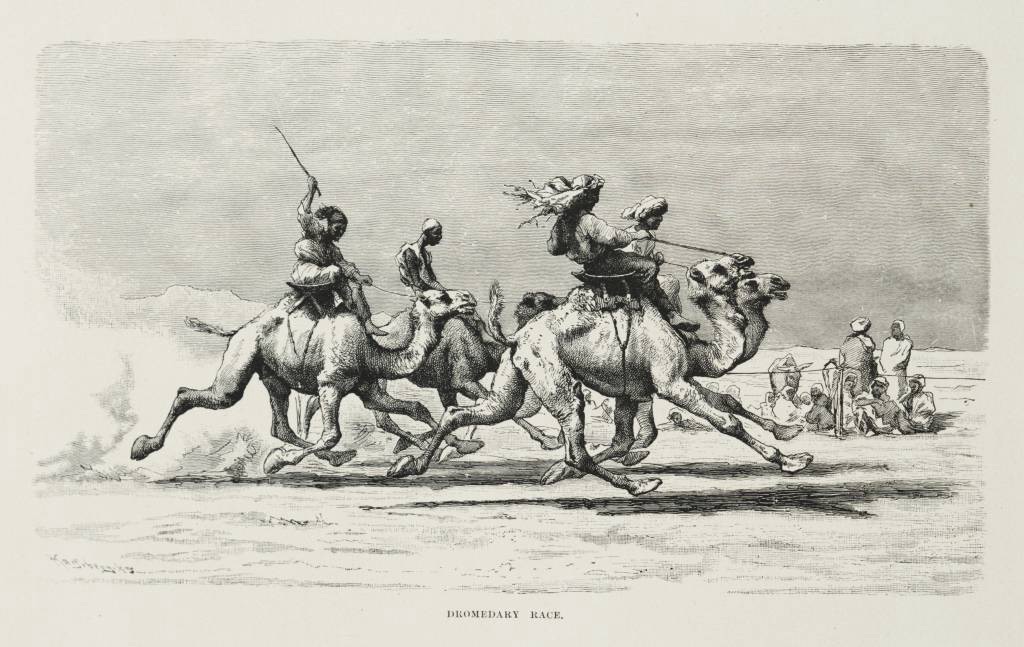

Camel racing is the sport of running camels at speed, over a set course, with lightweight riders or robot jockeys. The sport almost exclusively features the dromedary camel—its very name comes from the Greek dramein, “to run”—reflecting the animal’s natural design for speed.

On the Arabian Peninsula, the homeland of the dromedary, camel racing can be traced at least to the early Islamic period (7th century CE). Long overshadowed by horse racing, it remained a community sport at festivals and gatherings until the late 20th century, when it was transformed into a regulated, professional discipline with rules, governing bodies, and major investment.

Today camel racing is not confined to Arabia. Organized competitions are found in Kenya, Sudan, Egypt, India, and Australia, but the Arab states of the Gulf remain its epicenter. There, specialized industries now support the sport: controlled breeding programs, artificial insemination, embryo transfer, and intensive training methods—sometimes even treadmills and swimming pools—to prepare animals for competition. A proven race camel with a strong record can command extraordinary prices.
Races are typically grouped by age and sex, with distances adjusted accordingly: about 4 km for young camels and up to 10 km for older, mature racers. Because of differences in weight and performance, males and females are often run in separate categories, and females are especially favored on the track.
More than a sport, camel racing has become both an international attraction and a cultural showcase. Festivals combine competitive racing with traditional rituals and celebrations, preserving folk heritage for younger generations while presenting it on a global stage.
Today marks the first day of the Crown Prince Camel Race in Taif.
From September 2nd-12th
Leave a Reply