Ḥaqq al-Ḍayf (حق الضيف) and Karāmat al-Ḍayf (كرامة الضيف) in Arabian Moral Economy

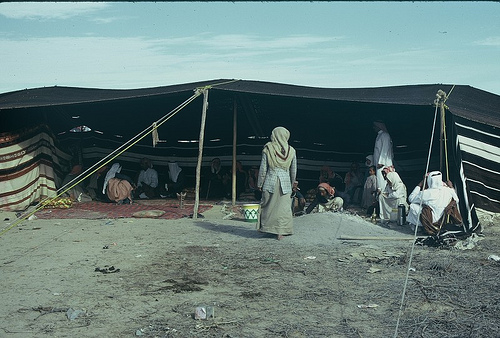
Hospitality in Bedouin society is not merely a social virtue but a normative system regulating survival, honor, and economic exchange in arid environments. This article examines the conceptual and practical distinction between Ḥaqq al-Ḍayf (حق الضيف)—the right of the guest—and Karāmat al-Ḍayf (كرامة الضيف)—the honor and generosity shown to the guest—situating both within Bedouin customary law (ʿurf, عرف), ritual practice, and moral economy.
Hospitality as Normative Obligation in the Desert
In Bedouin societies of the Arabian Peninsula, hospitality developed as a response to ecological precarity. Scarcity of water, mobility, and the unpredictability of travel necessitated a binding moral framework governing the treatment of strangers. This framework was articulated not through codified law, but through customary norms (ʿurf, عرف) transmitted orally and reinforced by poetry, genealogy, and reputation.
Within this system, hospitality is divided conceptually into two related but distinct categories: Ḥaqq al-Ḍayf (حق الضيف) and Karāmat al-Ḍayf (كرامة الضيف).
Ḥaqq al-Ḍayf (حق الضيف): The Inviolable Right of the Guest
Ḥaqq al-Ḍayf (حق الضيف) refers to the non-negotiable rights afforded to any guest, regardless of identity, origin, or social status. Crucially, these rights apply even when the guest is anonymous. This is even the case if a guest was to not identify themselves or why they are there.
Ethnographic and oral sources consistently identify the minimum provisions as:
- Water (ماء)
- Basic sustenance, often symbolized by salt (ملح)
- Shelter (مأوى)
- Physical safety and protection (أمان)
These rights are traditionally guaranteed for three days, during which the guest is neither questioned nor obligated to explain their presence. This temporal boundary reflects a balance between moral duty and social practicality and is widely attested in Arabian oral tradition and later Islamic-era legal commentary on pre-Islamic customs.
Ḥaqq al-Ḍayf is therefore ethical rather than performative. It is obligation, not generosity.
Karāmat al-Ḍayf (كرامة الضيف): Honor, Reputation, and Excess

Where obligation ends, Karāmat al-Ḍayf (كرامة الضيف) begins.
Karāmat al-Ḍayf denotes the host’s voluntary elevation of the guest through generosity, abundance, and social engagement. Unlike Ḥaqq al-Ḍayf, it is evaluative and directly contributes to the host’s reputation within tribal and intertribal networks.
Food and Symbolic Value
In Bedouin tradition, the honor shown to a guest is materially expressed through foods whose value lies not only in nourishment but in scarcity, effort, and cultural meaning. Notably, chicken and fish are absent from formal hospitality contexts, as they are associated with routine or sedentary foodways rather than symbolic generosity.
Instead, Karāmat al-Ḍayf (كرامة الضيف) is demonstrated through:
- Camel meat (لحم الإبل)
- Lamb (لحم الغنم)
- Game meat (لحم الصيد)
Historically, game meat—including gazelle, desert hare, oryx (al-mahā, المها), and even the uromastyx lizard (al-ḍabb, الضب) was offered when available. Such foods carried particular prestige, as their procurement required environmental knowledge, hunting skill, and physical endurance. Their presentation signaled not abundance alone, but competence and mastery of desert life.
The oryx (المها) occupied a distinct symbolic position in Arabian culture, often associated with nobility, endurance, and poetic imagery of the desert. The ḍabb (ضب), while more modest in symbolic register, represented resilience and adaptation; its consumption reflects practical desert subsistence knowledge and was culturally normalized in Bedouin contexts.
In contemporary settings, where hunting is regulated and subsistence practices have largely disappeared, such game meats, when legally sourced, may appear as delicacies, offered symbolically rather than as staples. Their meaning persists not in frequency, but in cultural memory and representational value.
Regional dish names may differ kabsa (كبسة) in central and northern Arabia, mansaf (منسف) in northern regions, and haneeth (حنيذ) in the south but the underlying symbolic structure remains constant: valued meat, communal consumption, and the public enactment of generosity and honor.
Coffee as Ritual Language
Hospitality formally begins with Saudi coffee (al-qahwa al-ʿarabiyya, القهوة العربية), served according to a structured ritual that communicates intention, protection, and closure. The traditional sequence consists of four cups:
- Qahwat al-Hayf (قهوة الهيف)
The host drinks first. This act assures the guest that the coffee is safe and that the host approaches the encounter in good faith. It establishes trust before any obligation is placed upon the guest. - Qahwat al-Ḍayf (قهوة الضيف)
The first cup served to the guest. Acceptance signifies recognition of hospitality and formal entry into the host’s protection. - Qahwat al-Kayf (قهوة الكيف)
Literally the “cup of enjoyment.” This cup is optional and signals comfort, ease, and social harmony. The guest may accept or decline it without offense. - Qahwat al-Sayf (قهوة السيف)
The “sword cup,” associated with alliance and defense. Historically, this cup symbolized a deeper bond, implying readiness to stand with the host in matters of honor or protection. It is rarely invoked in contemporary practice but remains part of the symbolic structure preserved in oral tradition.
This sequence functions as a non-verbal social contract, encoding consent, protection, and relational depth without explicit declaration. Ethnographic accounts consistently emphasize that altering the order disrupts the ritual meaning of hospitality. In fact if coffee is refused then this is a signaling that there is a feud between the host and his guest that must be resolved before pleastries are resumed.
Accompaniments and Deliberate Simplicity

Consistent with Bedouin minimalism, accompaniments to coffee and tea remain restrained. Dates (تمر) occupy a central role, often as the first food offered. Additions common in sedentary (ḥaḍarī, حضري) contexts—such as dried fruits or elaborate sweets—are notably absent in Bedouin settings, where simplicity reinforces authenticity and equality. It is considered most proper to eat dates in odd numbers.
Milk, Time, and Daily Rhythm
Milk, particularly camel’s milk (حليب الإبل), forms another axis of hospitality, structured temporally rather than ceremonially:
- Ṣubūḥ (صبوح) — morning offering
- Rawāyiḥ (روايح) — midday, around Ẓuhr (الظهر) and ʿAṣr (العصر)
- Ghubūq (غبوق) — evening, at Maghrib (المغرب)
These temporal distinctions demonstrate that hospitality is not episodic but embedded in daily life.

Ḥaqq al-Ḍayf (حق الضيف) constitutes a right grounded in survival and ethics.
Karāmat al-Ḍayf (كرامة الضيف) constitutes honor, grounded in reputation and moral capital.
Together, they form a coherent Bedouin code that regulated life, economy, and trust across the Arabian Peninsula long before the emergence of formal states or written law.

Leave a Reply